
by Simoné Cloete
by Simoné Cloete
Concentration camps were established in the British colonies of the Cape and Natal, as well as in the Boer Republics of the Orange Free State and the Transvaal.[i]
The term ‘Concentration camp’ has become synonymous with the Second World War and the Holocaust in contemporary minds. The South African concentration camps and the Nazi concentration camps should not be equated because that will do an injustice to the victims and survivors of both. It is therefore necessary to study the South African concentration camps and draw conclusion from that, without establishing a hierarchy of suffering or engaging in a comparative study. The South African camps were constructed to induce the Boer surrender, to remove the militant factor that the women posed, as well as house them since their homes were destroyed.
Suffering did not start at the concentration camps for the women and the children. For it was the women especially who also had to endure intense hardship since war was declared in 1899. They were, firstly, separated from their husbands or male family members who joined various commandos across the country which removed the protection that family men offered.[ii] The women then had to fend for themselves on their farms and still provide their families, servants, labourers and livestock with food and care.[iii] When the ‘Scorched Earth Policy’ was implemented, these women were faced with the terrible prospect of seeing their private possessions, which had been in the family for generations, burned to ash.[iv] A family farm and all the hard work built by generations destroyed in a matter of hours. Their livestock as a source of income were either requisitioned or slaughtered.[v] They were then taken far from their homes to live in tents with the minimum of possessions, clothes, food, or medicine.[vi] Then only did the camp ordeal start, with illnesses being rife and a tragically high child mortality rate.[vii]
Women inmates had to organise themselves and their families within the camps to establish some semblance of normality. The determination to win the war and strong religious belief were at the heart of the Afrikaner people, especially the women who instilled the beliefs in the next generation.[viii] Inmates found consolation and support in their religion and prayers.[ix] Sunday Church service and Sunday school were organised for the inmates.[x] Chaplain Luckhoff mentioned the ‘long and wearying prayers of the women’ who he ministered to.[xi] Letters by loved ones and emotional ties to the fighting men helped to sustain inmates mentally.[xii] The women in camps had to remain strong for their family members. Even the men fighting in commandos were made up of family groups in the civilian army.[xiii] The family ties strengthened their resolve, but it also made the loss of family members unbearably hard.[xiv]
Hunger was always an unwelcome companion in wartime, especially for civilians as can be seen with the ration distribution. There was also regular shortages of fresh vegetables and milk for babies.[xv] Adults and children who had family members on commando received less rations than the ‘protected burghers’.[xvi] The following represents an adult’s rations per day: 3/4 lb of either mealie meal, rice or potatoes, 1 lb of meat twice weekly, I oz of coffee daily, sugar 2 oz daily, and salt 0,5 oz daily.[xvii] 3/4 lb of white potatoes (Flesh and Skin) contains roughly 238 calories.[xviii] The addition of 1 lb of meat like beef (1,152 calories) to the diet would have increased the daily calorie content, however it would still have been below the recommended 2,000 calories per day for a healthy adult female.[xix][xx]
The women’s role of wife, mother and caretaker was very important. Domestic burdens continued, even in the camps where life had to resume to a version of normality but with much less in the way of resources. There were also, of course, no studies at the time, nor any knowledge of mental health issues that contemporary patients would be diagnosed with. Based on the knowledge we have today of the causes of Post-Traumatic Stress Disorder, it is certain that many women and children would have developed PTSD after the loss of their homes, the loss of a husband or father, the loss of a child or mother, the threat of death in the camps and the ongoing war which always takes a tremendous toll on civilians.[xxi]
The camps quickly became overwhelmed with the number of refugees, and diseases spread rapidly. In March 1901, only four months after refugees had been admitted, the total number of white Afrikaner refugees was approximately 35,000 refugees.[xxii] By September 1901, refugees numbered 110,000.[xxiii] As the number of refugees grew, so did the fatalities. In October 1901 over 3,000 fatalities were recorded – most of whom were children.[xxiv] Sir Henry Campbell-Bannerman, leader of the Liberal Party, asked the following question in June 1901: ‘When is a war not a war? When it is carried on by methods of barbarism in South Africa.’[xxv][xxvi]
The family in this photograph was taken at the Norvalspont camp in the Orange Free State.[xxvii] It shows the tents which entire families had to live in, and sometimes three or four generations had to share one space. The difference between the subjects in this photograph as opposed to the subjects boarding the train is vastly different. The few meagre possessions of the family can be seen on the edges of the tent opening. In the distance, a stack of firewood can be seen which was the only source of heat in the camps. The family were staged to sit by a photographer, however specific reasons for every family photograph remain obscure. There were rare instances where families with the money to spare had a family portrait taken in the camps, as several still exist.[xxviii] The purpose was mostly personal as it was sent to male family members still fighting or in prisoner of war camps.[xxix] It could also have been commissioned by the British authorities to portray the camp life and that of the inmates in a positive light.[xxx]
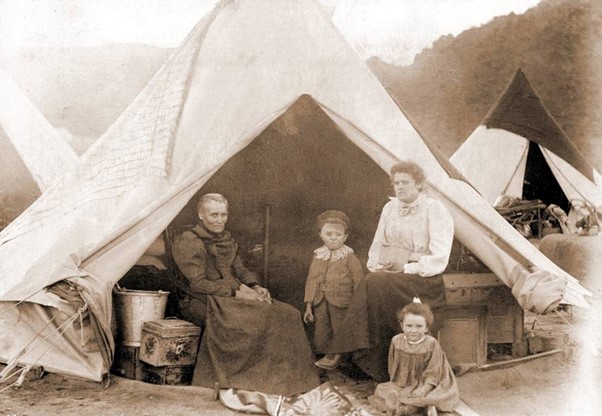
Image 13: Two women and two children in a tent in the Norvalspont Camp
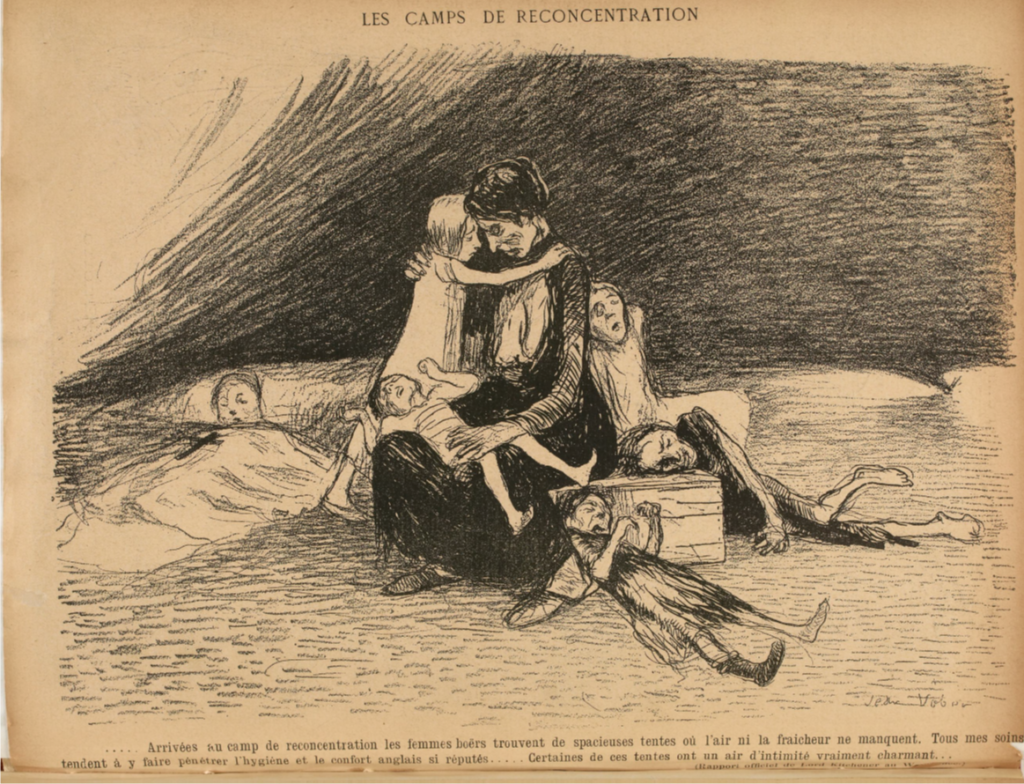
Image 14: Family Camp Poster by Jean Veber, ‘L’Assiette au beurre’, 28 September 1901
‘The Reconcentration Camps. Once arrived at the reconcentration camp, the Boer women find spacious tents where there is no lack of fresh air. All my care is aimed at bringing in the renowned English hygiene and comfort. Some of these tents have lovely privacy.’
Veber took a less favourable approach to the camp conditions. The image shows a bare breasted mother surrounded by six children. The child in the left corner has a Christian cross on its chest and implies that the child has passed away. The children who surround the mother seem to be sick, starving or dying. The exposed breasts of the mother represent the nurture and sustenance a mother can provide her children; however, this poor woman cannot provide her children with the care they need. Not in terms of food, hygiene, or medicine. The mother’s head is bowed in helplessness and rests against the head of her child who she holds close. Veber does not shy away from the harsh reality of what the women inmates experienced. He focused on the maternal loss and the inability to provide the basic needs of the children. The tents were close together and overcrowded, which meant that disease spread more easily.[xxxi] The tents also offered little privacy and little protection from the intense heat during summer months and the harsh winters.[xxxii]

[i] ‘British Concentration Camps of the South African War 1900-1902’ <https://www2.lib.uct.ac.za/mss/bccd/Histories/Bloemfontein/> [accessed 6 May 2022].
[ii] ‘Anglo Boer War – Hillegas: Chapter 10 – Boer Women in the War’ <https://www.angloboerwar.com/books/68-hillegas-with-the-boer-forces/1466-hillegas-chapter-10-boer-women-in-the-war> [accessed 9 May 2022].
[iii] ‘Anglo Boer War – Hillegas: Chapter 10 – Boer Women in the War’.
[iv] Smurthwaite, p. 144.
[v] Smurthwaite, pp. 144–45.
[vi] Smurthwaite, p. 144.
[vii] ‘Anglo-Boer War Museum’.
[viii] Britz, p. 22.
[ix] Britz, p. 27.
[x] Britz, p. 33.
[xi] A D Luckhoff, Women’s Endurance (Cape Town: SA News Co Ltd, 1904), p. 49.
[xii] Michael Godby, ‘Confronting Horror: Emily Hobhouse and the Concentration Camp Photographs of the South African War’, Kronos, 32, 2006, 34–48 (p. 39).
[xiii] Smurthwaite, p. 29.
[xiv] Britz, p. 42.
[xv] ‘Anglo-Boer War Museum’.
[xvi] Pretorius.
[xvii] ‘Anglo-Boer War Museum’.
[xviii] ‘Calories in 3/4 Lb of White Potatoes (Flesh and Skin) and Nutrition Facts’ <https://www.fatsecret.com/calories-nutrition/usda/white-potatoes-(flesh-and-skin)?portionid=48885&portionamount=0.750> [accessed 10 May 2022].
[xix] ‘What Should My Daily Intake of Calories Be?’, Nhs.Uk, 2018 <https://www.nhs.uk/common-health-questions/food-and-diet/what-should-my-daily-intake-of-calories-be/> [accessed 10 May 2022].
[xx] ‘Calories in 1 Lb of Ground Beef (80% Lean / 20% Fat) and Nutrition Facts’ <https://www.fatsecret.com/calories-nutrition/usda/ground-beef-(80%25-lean—20%25-fat)?portionid=41310&portionamount=1.000> [accessed 10 May 2022].
[xxi] ‘Overview – Post-Traumatic Stress Disorder’, Nhs.Uk, 2021 <https://www.nhs.uk/mental-health/conditions/post-traumatic-stress-disorder-ptsd/overview/> [accessed 10 May 2022].
[xxii] Smurthwaite, p. 150.
[xxiii] Smurthwaite, p. 150.
[xxiv] Judd and Surridge, p. 194.
[xxv] Judd and Surridge, p. 11.
[xxvi] ‘On This Day 14-6-1901 – Liberal History’ <https://liberalhistory.org.uk/timeline/on-this-day-14-6-1901/> [accessed 3 March 2022].
[xxvii] ‘Snapshot’ <https://maroelamedia.co.za/goeiegoed/goeie-nuus/fotos-hier-asem-jy-erfenis-in/> [accessed 14 March 2022].
[xxviii] Godby, p. 38.
[xxix] Godby, p. 38.
[xxx] Godby, p. 45.
[xxxi] Pretorius.
[xxxii] ‘British Concentration Camps of the South African War 1900-1902’.