
by Simoné Cloete
by Simoné Cloete
The road to War was a complicated escalation of tensions during the second half of the nineteenth century. Southern Africa consisted of the British Cape Colony and Natal and two northern Boer Republics; The Transvaal and the Orange Free State.[i] By 1881, the Transvaal were granted self-rule with only limited British interference.[ii] The Transvaal and Orange Free State held little appeal to the British as the land was seen as rough, barren and with little natural resources to warrant further interference.[iii] On 9 May 1883, Paul Kruger was elected the first president of Transvaal.[iv] Kruger was a self-taught man of considerable intellect, self-assured and held a strict Calvinistic view on religion.[v] Strong religious views were shared by many Afrikaner Boer families which would be invaluable in the camps when women needed courage and hope to carry on through hardships and suffering.[vi] The population consisted of the Dutch, German and French Huguenot settlers who had in earlier centuries escaped Europe from religious persecution in the search of freedom.[vii]
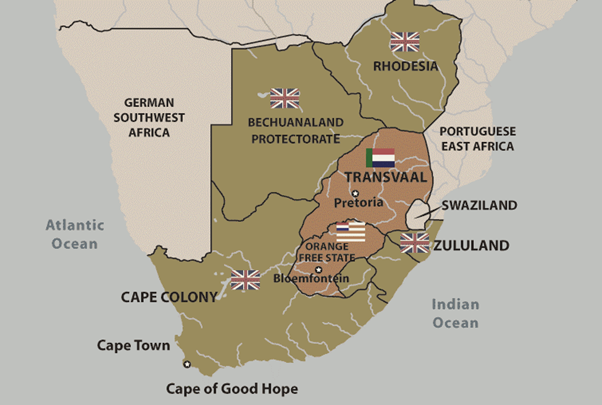 Image 2: Map of Southern Africa Showing the British Colonies and the Boer Republics
Gold Rush
In 1886, a substantial gold reserve was found at the Witwatersrand or Ridge with white water. This discovery changed the course of South African history.[ix] The barren hinterland of Southern Africa became appealing to all – especially the British. By 1898, the Transvaal had overtaken America as the single largest producer of gold.[x] The growth of the gold market meant an increase of immigration to the Transvaal from Britain, America, Australia, and Germany.[xi] People from all over the world were drawn to the newfound wealthy state in search for their own piece of prosperity.
The Jameson Raid
Colonial Secretary, Joseph Chamberlain, and Prime Minister of the Cape, Cecil Rhodes conspired to topple President Kruger’s government in 1895.[xii] The attempted coup would become known as the Jameson Raid which was ultimately unsuccessful. The Colonial Secretary Joseph Chamberlain tasked Alfred Milner, the High Commissioner of Southern Africa with the reintegration of the Transvaal into the British dominated Union of South Africa.[xiii] Their motivation for this was to protect the Uitlanders, meaning white, English-speaking immigrants, from hostility by the Dutch Afrikaners. A military alliance was formed by President Kruger and President Marthinus Steyn of the Orange Free State. Tensions grew and peace talks collapsed between Milner and Kruger.[xiv] By mid-September 1899, nearly ten-thousand British troops embarked for South Africa.[xv] The Transvaal Attorney General Jan Smuts drew up an ultimatum demanding that Britain withdrew its troops, however war was declared on October 11th, 1899.[xvi]
The Declaration of War
The British Army that landed in South Africa consisted of lower-class men who served as ordinary soldiers, and aristocratic men who served as officers.[xvii] The Boer army was different in every way and was a true citizen’s army.[xviii] Men aged 16 to 60 were eligible for military duty and was required by law to provide their own horse and rifle and join their nearest commando.[xix] As the Transvaal was mostly agrarian, it meant that Boers had no official military training and were mostly farmers, or sons of farmers.[xx] Their knowledge of rifles would have been practical knowledge acquired through teaching, living off the land and protecting their livestock from predators.[xxi] Therefore, the commandos consisted of entire male family groups and communities which provided a cohesive and patriotic setting, unlike the average British soldier would have found.[xxii] Their family, religion and community were of utmost importance to them.[xxiii] The Boer churches viewed the War as an unjust one, however when the war started, they trusted God’s providence and used phrases such as ‘God rules our destiny’ and ‘God is on the side of the oppressed’.[xxiv]
The professional British Army would however, come to realise that the Boer citizen Army was not an easy target.[xxv] Two months after war was declared the British Army suffered three devastating defeats by the Boer Republics at the battles of Stormberg, Magersfontein and Colenso.[xxvi] These events became known as Black Week (10–17 December 1899).[xxvii] Commander and Chief of British Forces in South Africa, Sir Redvers Buller, was relieved of his post and replaced by Field Marshall Lord Roberts.[xxviii] An experienced military man, Roberts had seen action and military success in India, Afghanistan, and Ireland.[xxix] In 1900, Roberts had new resolve to end this colonial war which should have been easily won against such an enemy as the Boers. By the end of 1900 Roberts had not defeated the Boers and left for London where he was promoted to Commander in Chief of the Army while General Kitchener assumed control.[xxx][xxxi] Kitchener was determined to bring the war to a swift end, it would however, take him a further eighteen months to reach peace.[xxxii] Kitchener’s tactics to win the war included the construction of concentration camps for civilians and the scorched earth policy.[xxxiii]

[i] ‘Boer War | National Army Museum’.
[ii] David Smurthwaite, The Boer War 1899 -1902 (London: Octopus Publsihing Group, 1999), p. 19.
[iii] Smurthwaite, p. 19.
[iv] Smurthwaite, p. 18.
[v] Smurthwaite, p. 18.
[vi] Dolf Britz, ‘“Now, What Has Become of Our Prayers and Supplications?” Faith in an Anglo-Boer War Concentration Camp of 1901’, Acta Academica, 39.3 (2007), 21–44 (p. 21).
[vii] Smurthwaite, p. 13.
[viii] ‘WarMuseum.ca – South African War – Boer War Maps’ <https://www.warmuseum.ca/cwm/exhibitions/boer/boerwarmaps_e.html> [accessed 7 January 2022].
[ix] Judd and Surridge, p. 32.
[x] Lodewyk Verhoef, The Boer War ( The Story of the Boer War ), 2018 <https://www.youtube.com/watch?v=XOPwZB2rIFo> [accessed 5 May 2022].
[xi] Smurthwaite, p. 22.
[xii] Judd and Surridge, pp. 37, 38.
[xiii] Judd and Surridge, p. 44.
[xiv] Judd and Surridge, p. 47.
[xv] Judd and Surridge, p. 50.
[xvi] Judd and Surridge, p. 27.
[xvii] Lodewyk Verhoef.
[xviii] Lodewyk Verhoef.
[xix] Smurthwaite, p. 29.
[xx] Smurthwaite, p. 19.
[xxi] Smurthwaite, p. 29.
[xxii] Smurthwaite, p. 31.
[xxiii] Britz, p. 27.
[xxiv] Britz, p. 28.
[xxv] ‘Boer War | National Army Museum’.
[xxvi] Smurthwaite, p. 52.
[xxvii] Smurthwaite, p. 52.
[xxviii] Smurthwaite, p. 52.
[xxix] ‘Frederick Roberts: Bobs | National Army Museum’ <https://www.nam.ac.uk/explore/frederick-roberts-bobs> [accessed 5 May 2022].
[xxx] Smurthwaite, p. 141.
[xxxi] Lodewyk Verhoef.
[xxxii] Lodewyk Verhoef.
[xxxiii] Smurthwaite, p. 141.